
Grants Pass Previous Resident Sources
Previous-resident research needs an era-specific source. Josephine County's property portal is a current starting point, not a complete historic roster. The Clerk's online document system has no published earliest online date. For older material, the Oregon State Archives inventory, local history desks, and the library collection path are part of the normal search, not a last resort. Use a source for the question it can answer: land ownership, a listed address, an enumerated household, or building context.
| Source | Verified reach | Where held | What it can show |
|---|---|---|---|
| JCPA assessment and tax data | Current portal; earliest online date not stated | JCPA and Assessor counter | Current property fields, map/legal description, and sales-history bridge |
| Clerk Digital Research Room | Current online system; cutoff not stated | Digital Research Room and Recording Division | Recorded-document index and images subject to its disclaimer |
| Clerk and Recorder miscellaneous recordings | 1856-1981 | State Archives inventory and named repositories | Older deeds, conveyances, mortgages, wills, liens, and related filings |
| Selected Grants Pass directories | 1910, 1923, 1947, 1953, 1961, 1962, 1964, 1967-68 | JCHS, JCLD, and catalogue routes | Dated printed listings, not a continuous run |
| Federal census | 1790-1950 released by 2026 | Libraries, archives, and federal research services | An enumerated household on the census date |
| Grants Pass Sanborn maps | 1888, 1894, 1898, 1907, 1911 | Library of Congress | Street and building context, not names of residents |
The Josephine County Historical Society Research Library is the local in-person fallback for documents, maps, newspapers, and family histories.
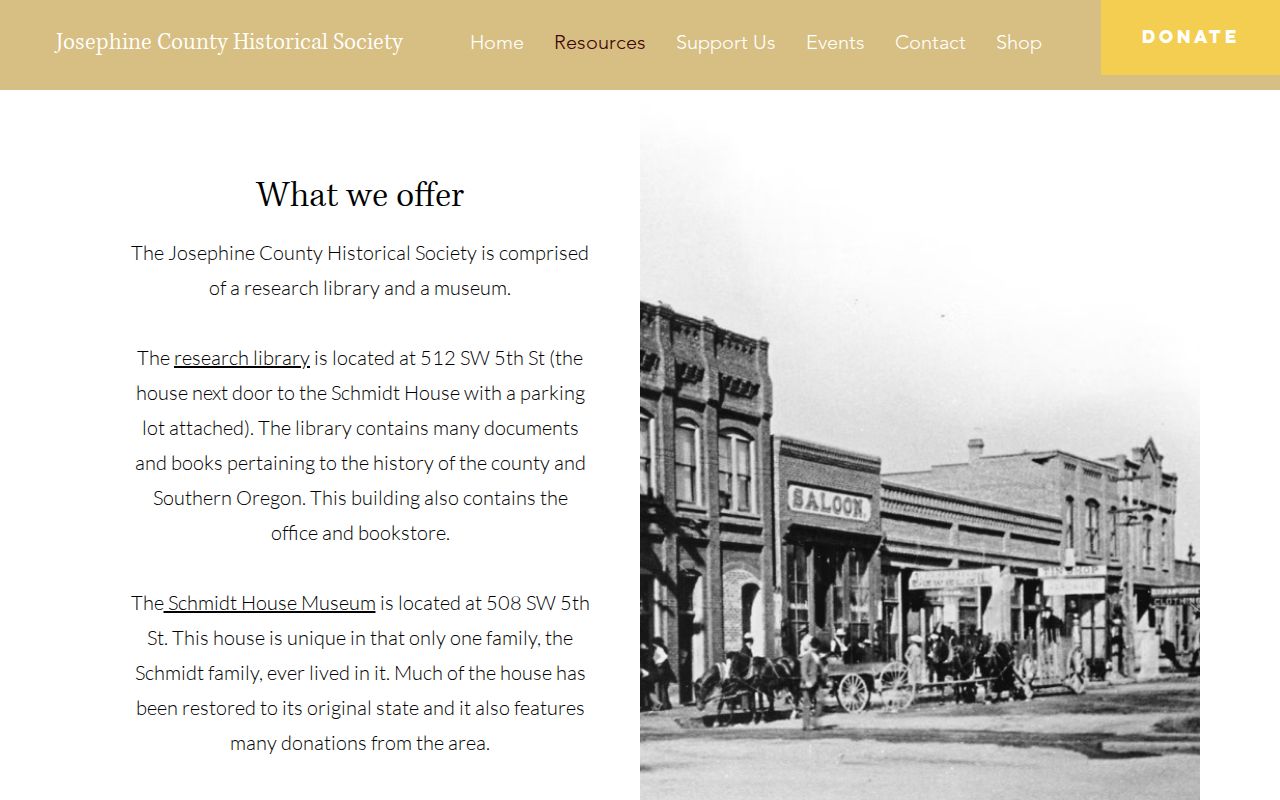
Its non-lending resources reward a focused visit with an address, name variant, and date range. The Research Library is at 512 SW 5th Street, Grants Pass, with published Tuesday through Friday hours of 10 a.m. to 4 p.m. and telephone 541-479-7827.
Note: Bring an address, name variant, and date range because the historical materials are non-lending resources.
Grants Pass Past Address Evidence
Start a past-residents trail with the Josephine County Property Assessment & Tax Data card for the present parcel. Preserve its full situs, map number, legal description, current owner field, and owner mailing field. A situs is the physical parcel location used for mapping. The mailing field is tax correspondence and can point to a post-office box, an agent, an estate contact, or another property. It should never be treated as proof that a person lived at the situs.
The same card can show property status, type, neighborhood, zoning, values, tax lines, and sales-history rows. The useful backward link is the instrument number, coupled with the buyer and seller roles. That link is stronger than a street string when an address was reformatted or when a historic source relies on a lot, block, subdivision, or map reference.
Trace Grants Pass Past Deeds
Ownership records and past residents are different evidence streams, but a deed chain gives the structure for an address history. The Josephine County Clerk & Recorder records deeds, mortgages, liens, plats, easements, land-sale contracts, and related documents. Work backward from a documented parcel and keep the legal description constant. A JCPA sales-history table is a bridge to the document index, not a complete title opinion.
- Save the current JCPA parcel identifiers, legal description, and relevant sales-history instrument number.
- Search the instrument number or current buyer in the Digital Research Room.
- Read the document's party roles and identify the prior seller. Search that person or entity as a grantee to locate the earlier acquisition.
- Repeat backward while recording document number, recording date, book or page when supplied, party role, and the stable parcel description.
- If the online search does not return the needed record, use the Recording counter, its direct line at 541-474-5240, a copy request, or the archival repository named in the State Archives inventory.
- Grantor
- The party conveying an interest in a recorded document.
- Grantee
- The party receiving that interest. In a backward chain, a prior seller can appear as grantee on an earlier purchase.
- Chain of title
- The sequence of recorded transfers and related instruments connected to one parcel.
- Legal description
- The parcel-identifying language that can outlast a street-name change or uneven address numbering.
Grants Pass Previous Resident Records Offline
An online miss is not the end of a Grants Pass address trail. The Digital Research Room requires agreement to its disclaimer and an anti-robot check. It says displayed images are not certified and does not state an online cutoff. For a certified copy, an older book, or a result that cannot be found online, go to the Josephine County Recording Division during weekday 8 a.m. to noon and 1 to 4 p.m. counter hours, call its published line, or make a written copy request. The division specifically refers older-record researchers to the Oregon State Archives and Rogue Valley Genealogical Society.
The Recording Division lists the scope and counter route for the recorded materials behind an address history.
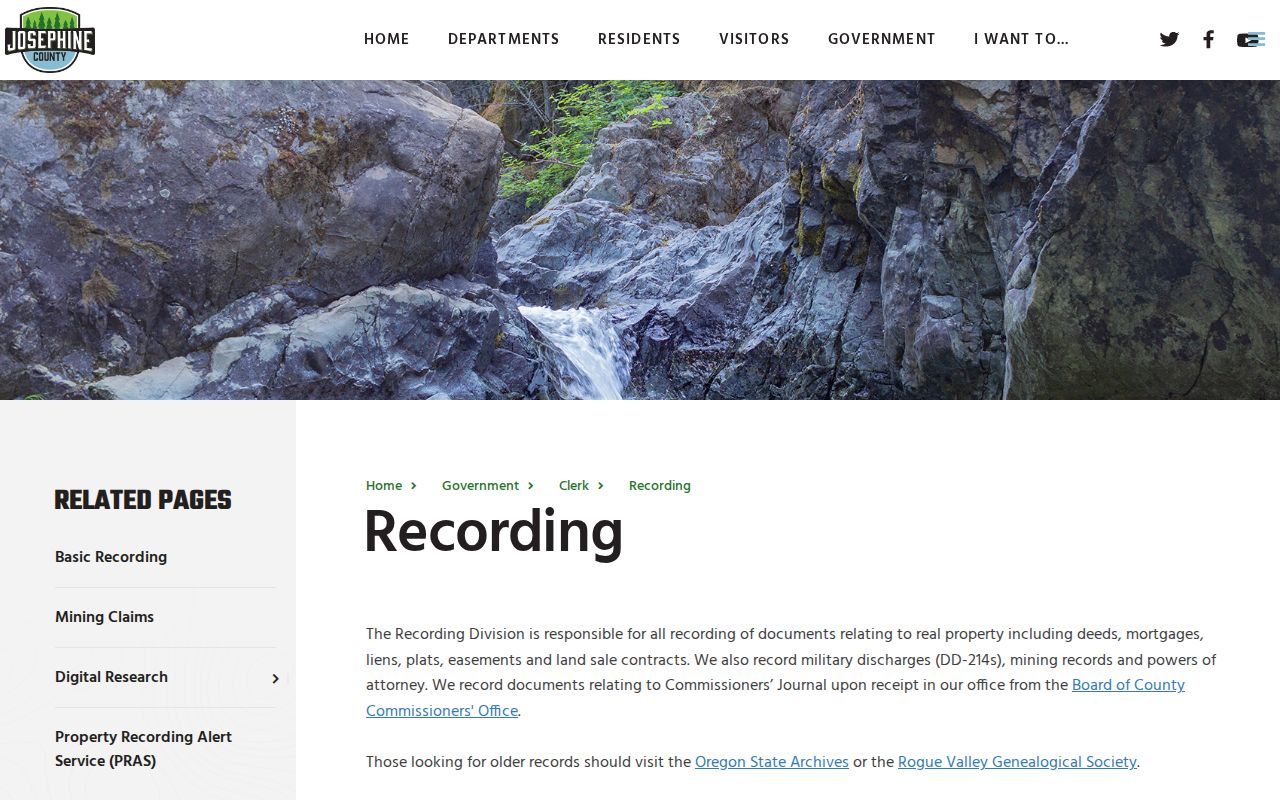
The Oregon State Archives Josephine County inventory identifies Clerk and Recorder Miscellaneous Recordings from 1856 through 1981 and points to custody locations. It is a locator for real books and collections, not a promise that every item is digitized.
Note: A certified copy or an older volume requires the Clerk counter, request route, or named repository.
Date a Grants Pass Address
Sanborn fire-insurance maps help establish a historic street and building setting. The Library of Congress makes Grants Pass editions from 1888, 1894, 1898, 1907, and 1911 available without charge. The 1911 edition has 19 sheets. These maps can show a building footprint, material, use, street layout, and numbered-block context. They do not identify a household, so use them to test the address form before attaching a name from a directory, newspaper, or census.
Street variants matter. National Register material for the G Street historic district notes that SW G Street had “Front” and “Main” associations. Search dated variants before deciding a record is absent. The city grid and its directional prefixes are helpful for modern records, but an old source should be preserved as printed.
Pair Grants Pass Directories and Census
Directories and census schedules add a household layer, but neither replaces a deed. The verified Grants Pass directory editions are scattered rather than a continuous sequence. Before using an address-to-listing volume, ask Josephine Community Library District or JCHS whether it holds a reverse or criss-cross edition for the exact year. No verified public catalogue establishes a complete Grants Pass reverse-directory run. The historical editions and their collection routes are kept with the Grants Pass city directories.
- Choose the documented directory edition closest to the target year and copy the entry exactly as printed, including page, publisher, date, and name variation.
- Confirm whether the volume is alphabetical or address based before drawing an address conclusion.
- Compare the result with the appropriate federal census, which identifies an enumerated household on its own census date.
- Use the parcel legal description, deed trail, Sanborn map, newspaper, probate, or cemetery evidence to resolve conflicts instead of merging similar names.
Note: A directory places its listed entry in one published edition, while a census and deed describe different events and dates.
Past Grants Pass Households
For a household question, label the evidence carefully. A city directory can provide a dated printed name, business, or address element when present. A census provides an enumerated household on the census date. A deed names recorded parties, and a Sanborn sheet provides place context. Those sources can reinforce one another, but they should not be flattened into a single statement about who lived at an address over time.
The Rogue River Courier is available through the Library of Congress for 1886 through 1927, with predecessor and daily-edition context. RVGS indexes selected obituary, clipping, and mortuary materials. Request a cited obituary, clipping, or collection result with its date rather than drawing a continuing-address conclusion from a notice. The Oregon Historical Records Index can also lead to estate, guardianship, naturalization, and related records, but an index hit is a lead to its custodian, not necessarily an online image.
Lawful use. Grants Pass previous-resident research is suited to family, estate, and property history. Never use a historical address trail to stalk, harass, intimidate, or harm anyone.
Grants Pass Records Began Elsewhere
Early Josephine County work may not begin in Grants Pass. The county was created in 1856, with an original seat at Sailor Diggings, then Kerbyville, before Grants Pass became the county seat in 1887. That change explains why older sources can be filed under earlier places or use a different address form. The State Archives inventory identifies early assessment, census, naturalization, probate, deed, and plat series and is the right starting place for a pre-city record trail.
The inventory also describes JCHS deed and mortgage copies for 1855 through 1898 and a modern Book of Records from 1980. These are custody and format milestones, not proof of an unbroken digital archive. A dated record with its repository name is more useful than an assumed continuous file.
The county-records guide grew from Oregon's 1993-94 Historical Records Project, with roots in the late-1930s WPA Historical Records Survey. That history explains why the inventory points to volumes, microfilm, courthouse holdings, and repositories instead of acting like a live search screen. From 1900 onward, only tax rolls for years ending in 0 or 5 were permanently retained, another reason to match a past-residents question to the specific series and era.
Note: A county-seat change or retention limit can require a different repository even for the same parcel.
Limits of Grants Pass Past Results
Past residents of a Grants Pass address cannot be established from a single current property card. An owner field, a mailing field, a recorded party, a directory entry, an obituary, and a census enumeration each describe different facts. Keep their dates and limits visible. Older files may be held at the Clerk, State Archives, JCHS, library, or another named repository, and access can depend on the series. Some modern records and protected address information are not available through an ordinary records request.
Note: A carefully cited address history is stronger when every step names the document, collection, date, and custodian.